Showing posts with label International Development. Show all posts

Tuesday, April 17, 2012

Visiting a Sponsor Child - Part Two

Hello again!

Sorry it has taken me so long to update my blog. If you remember a few weeks ago, I mentioned that I was going to visit my dad's cousin's sponsor child in Visiting a Sponsor Child - Part One. Here is part 2 of that story, detailing how my day went visiting Jackeline.

I met Soledad, the Compassion trips coordinator at my house at 9:30 am sharp (I love it when things start on time!). We took two taxis (for a little over an hour total) to San Juan de Lurigancho, a district in Lima, where Jackeline lives. We had a great trip: she answered all of the questions that I had, gave me information about the family I was about to visit, and chatted about different things in Lima. A great start to the day.

Our first stop was at the local Compassion office. Here we met the Director, Marisol, and the Manager, Ilda, and they explained how the office works and what they do. Here are a few pictures to describe the location.

Kids learn about life skills: physical (to determine when they are sick with diseases such as Tuberculosis or Diarrhea), socio - emocional (to talk things through instead of to fight), spiritual (not to have fear, God is with you), cognitive (I am smart, I can do it). The examples in each category change each day, and they have a discussion with the Compassion staff about it to gain awareness and self-esteem.

Thursday, March 22, 2012

Visiting a Sponsor Child - Part One

Good morning!

Several weeks ago, my Dad's cousin went for dinner at our house in Ottawa, and they ended up talking about the fact that I am in Peru, about the type of work that I am doing, etc. My Dad's cousin (Rod) told my Dad that he was actually sponsoring a child through Compassion Canada, and that she lives on the outskirts of Lima. In the days following that supper meeting, emails were exchanged, and the topic of visiting the sponsor child came up. I offered to go meet her (much to Rod's delight), thus starting a 2-month process to get everything organized and put into place.

At the beginning of March, I had a business trip to Cajamarca with one of my colleagues as a part of the pilot project and implementation of the National Pollutant Release Inventory in Peru. On our flight to Cajamarca, the topic of sponsor children came up - without me even mentioning the fact that I might be visiting one too, that our family used to sponsor a child in Bolivia, and that I know of many others who also send money abroad on a monthly basis. He brought up the case of a few organizations that work in Peru, go into certain communities, snap pictures of children, and then post them on the web for all to see in the hopes of receiving more donations. But then, where does most of the money go? Printing costs, administration, visits, phone calls, mailing documents, etc..... and perhaps very little of it actually reaches the child and the family that the funds are directed to. Some organizations are better than others he said (and some flat out don't deliver what they promise), but it is still not a very effective way to reach out to others in his opinion.

Monday, March 5, 2012

Promoting Sustainable Housing and Buildings for Climate Change Mitigation in Peru

Hello,

On February 16-17, 2012, I attended the Canada-Peru Workshop on Sustainable Housing/Buildings for Climate Change Mitigation, as part of my internship. This joint initiative between the Canadian and Peruvian Ministries of Environment brought together specialists from Canada, the United States, Mexico, Peru, Chile, and Germany. The first day of the conference consisted of a workshop for 60 participants in the building, governmental and financial sectors in Peru to discuss case studies in Canada and Mexico, technological advances in sustainable building technologies, and financing for such projects, among other things. Day 2 brought together a small nucleus of scientists and specialists to formulate the platform for the Nationally Appropriate Mitigation Action Strategy (NAMA). As an intern at the Ministry of Environment, I led break-out groups in the afternoon on the first day, and participated in discussions on the second day.

Monday, February 20, 2012

What exactly is international development?

Four weeks ago I began a new field placement with the Ministry of Environment of Peru in Lima. Transitioning from work at the water utility in small-town Huacho to living in the financial district of Lima has been quite a drastic change, and has led me to wonder: what exactly is international development, and am I still doing it?

Discussing this topic with other international volunteers has led to quite a few interesting responses. Some people definitely think that doing ‘field work’ involves not working in an office, but the reality is that you spend most of your time in front of a computer or at meetings, just as you would back home. An American volunteer that I recently met told me that she had left her office day job in Ohio in the hopes of finding an alternative abroad (and also strengthen her Spanish), only to find herself working 40 hours a week at a desk in Lima (yet still enjoying herself).

Meanwhile, most of the international volunteers and interns that I have spoken with are experiencing the life of working for an NGO: funding difficulties, changes in mandates, employees leaving unexpectedly, shortage of supplies, and questionable governance. They are mostly working directly with the community and really contributing to development activities from the ground up.

Wednesday, December 21, 2011

Reflections on Christmas and Development

On Saturday, December 16th, 2011, I was invited to attend a chocoletada – an event where you drink a warm milk chocolate drink and eat panetón, a take-off of the Italian fruit bread panettone that is very popular in Peru for Christmas. But this chocoletada was not like any other – it was a way to earn votes. The next municipal elections are not until 2014, but one of my ex-colleagues at EMAPA Huacho is already trying to win as many votes as he can in order to become the next mayor of Santa María, a district next to Huacho. And one of the ways he wanted to achieve this was by organizing a free chocoletada in one of the poorest neighbourhoods in town.

His friends were asked to come along and help make the event run smoothly. There was music and a kid’s show, followed by the distribution of hot chocolate and panetón. While everyone was busy enjoying their treat, the candidate mayor made speeches and brought up people from the community to talk. But instead of talking about the holiday season, the talk was about how the community still has no water or waste water and thus uses communal latrines, and how if he is elected, he will change this. There were testimonies from elders in the community talking about difficulties and struggles that they face. It just goes to show that no matter what event you are attending, politics always seems to be brought into the mix here.

Friday, December 2, 2011

Making powerful decisions

Hello everyone,

I'd like to share with you what I've been doing at work for the past few days, because it's been quite eventful. And soon I promise to update you on my trip to Tarapoto (just need to find the time).

Two weeks ago (before I went to Tarapoto) we had a meeting at the municipality with a citizen's group from the south (where the urban expansion is) because they want water and waste water connections. We decided that we would visit them this week (on Tuesday) and have a follow-up meeting at the municipality next Tuesday (Dec. 6th). Our visit went well on Tuesday, and we told them that we would put together a preliminary budget so that when we are at the municipality we can talk about financing and who will cover what costs. So we started working on that (Juan and I). Well, Wednesday at 11am we got a call from the general manager of EMAPA saying that he wanted the information by 8am on Thursday so that he could look it over and start looking for financing from his end. Less than 24 hours! Ouf, so we kicked things into high gear. But then on Wednesday afternoon there was an emergency in the construction side: they are digging trenches to put in the plumbing for water and waste water somewhere in Huacho, and one of the electrical poles was not properly installed so it fell over and was leaning against a house. Luckily no one was injured and the electrical wires didn't break, but it could have been much more serious. So Juan spent most of Wednesday afternoon there (and I needed to talk to him to move on with my work) and he only got back at 5pm.

Wednesday, November 30, 2011

My busy month of November

Hello everyone,

I'll take a few minutes to update you on my life - a bit behind schedule, but that's okay (better late than never, right?). The beginning of November was pretty quiet in my life (although quite hectic everywhere around me - see my last blogpost to find out why). But once the first weekend passed, the rhythm of things picked up quite a bit.

On Tuesday, November 8th, I successfully completed my first solo trip in Peru: nothing big, but I went to Lima alone. I was let out of work a bit earlier in the afternoon so that I could catch my bus and get to Lima before the sun went down. The trip went very smoothly: I arrived in Lima shortly after 6pm and then took the bus straight away to Miraflores (the safest, cleanest, nicest part of Lima). When I got off the coach bus I was excited to be travelling alone again; I had forgotten the rush of how it feels. I mean, I carefully researched exactly where to go so I wouldn't look lost and would be efficient with my time, but it was nice to be independent and self sufficient. SUCH A GREAT FEELING. And I felt much safer this time in Lima. Probably because I know from where to where I was going and now I am familiar with the area, so it is not as scary. Also, my Spanish is much better than when I first got here (I kept thinking back at how much time had passed since the first time I did the trip from Lima to Huacho).

Thursday, October 27, 2011

A day in the field: Trip to Santa Rosa

Hello everyone!

I hope this post finds you all well as October is winding down to an end! I'd like to share with you what I learned, saw, experienced, and felt yesterday when I travelled to Santa Rosa with the EMAPA crew. It was a really eye-opening trip, and definitely one of the highlights of my time here so far in Peru. You know when you just have a day that really stands out and makes you think? That's how I felt yesterday. It was a great way to celebrate the 7-week mark of my time here (as of today, I have been here for 50 days already! Times flies!).

This is someone's house.

Monday, October 17, 2011

My work at EMAPA Huacho

So, what am I actually doing for my field placement? As most of you may know, I am currently completing an 8-month field placement in Huacho, Peru. But what else?

I am working for a local water utility, EPS EMAPA Huacho S.A., focusing on user education and on environmental assessments (EA). I am studying the feasibility of the construction of three new water purification plants, which includes writing the terms of reference, compiling baseline data and completing studies of the physical, biological, social, cultural, and economic impacts of the project. I am working directly with the head sanitation engineer to complete the three EAs required (since EMAPA is going to build three waste water treatment plants in different areas of the region), while bringing a different perspective to the analysis of the situation. As we are in a low-lying coastal area that is prone to earthquakes (there was a magnitude 4.1 earthquake here my first week, but I didn't feel it), the potential waste water treatment plants need to be able to resist to certain natural disasters. We are also analyzing the risk of toxic matter leeching into aquifers in the case of a failure with the structure. The proximity of the waste water treatment plants to human dwellings is also of concern (legislation states that it must be at least 500 m away from the closest houses, but in one city the plant may be built as near as 100-150 m away from the closest properties for lack of other land). Planting a ring of trees around the facilities has been planned to help reduce the unpleasant odours that will be released during the water treatment process. Furthermore, we are planning preventative measures to reduce the risk of mosquitoes and other insects from breeding near the treatment plants. Throughout our analysis, we must keep into consideration cost, local knowledge (for when maintenance issues arise) and general needs of the population.

Thursday, September 22, 2011

A day in the field: Trip to various locations around Huacho

Tuesday, September 20th, 2011, Itxel and I got the privilege to go on another field trip with the sanitation engineer Juan Candia Cuno. This time, we got to visit different regions of Huacho (the city where we are living) - but not the touristy version.

Our first stop was the port. This is a pretty busy area (and not very safe), as there are many commercial and local fishers. Since we were there in the afternoon, we got to see some of the local fisherman pulling their boats out of the water.

Typical afternoon at the port in Huacho

Tuesday, September 20, 2011

A day in the field: Trip to Sayán and Végueta

Friday, September 16th, 2011, Itxel and I headed to visit two other districts in the Huaura province, Sáyan and Végueta. They both receive water treatment services from EMAPA Huacho. Sayán is roughly a 45-minute drive inland and into the mountains, while Végueta is right on the coast, about 20 minutes north of Huacho. We spent the day visiting the two sites with an engineer from EMAPA Huacho, Juan Candia. He wanted to show us the potential locations for new waste water treatment plants in both of these locations.

From everything that I have learned so far in Huacho, this is how their water system works:
1) Pump water from the ground.
2) Inject water with chlorine gas to help clean it.
3) Pump water up to a water tower on a hill/elevated area, to insure water pressure throughout the town.
4) Water drains down into subscriber's homes/businesses using the flow of gravity (only Sayán has continuous service 24 hours/day).
5) Waste water drains by means of gravity to a central location.
6) Untreated waste water gets dumped into river (in the case of Sayán) or ocean (in the case of Végueta and Huacho).

Waste water from Sayán going straight into the River Huaura

Thursday, September 15, 2011

First official day of work in Huacho (and everything that's happened up until now)

Well hello again!

I hope you are all having a great first (or second) week of classes for those of you who are in school, and that everyone in the northern hemisphere is enjoying the arrival of fall. I for one cannot wait for spring to come - only 6 more days! - because that will mean sun and the arrival of warmth here in Huacho! I can't complain though, it is around 15-20 degrees every day, but it gets chilly at night, and as it is humid and there is no heating, there is no escaping the cold! Let me fill you in on what has happened since the last time that I wrote to you! (It feels like an eternity has passed, even though it's only been 3 days!)

Alright well Tuesday was a day full of ups and downs - I think that until now I had told myself to be strong and to carry on and not to worry too much, but Tuesday morning I woke up feeling a bit lonely and isolated. As you may have read, Monday was such a busy day and I met so many people, but I was starting to feel that I could not let my personality shine through fully and that I was much quieter than my normal self.

Tuesday, September 13, 2011

My first day in Huacho

*Note: I wrote this last night but did not have access to internet, hence why I am posting it now.

My first day in Huacho – oh my goodness, I am so tired, all I want to do it to go to bed. But so much has happened today that I want to try to document as much as I can to share it with you all. As soon as I am done, I am calling it a night (and I will post this in my blog tomorrow or the day after that when I have internet access).

Well, let’s start with this morning. I was in Lima. Feels so far away now. I had originally been told I was going to be picked up sometime after 8am to go to the bus station to come to Huacho. So I set my alarm for 7am, thinking that would be enough time for breakfast and such (I packed the night before). Well, at 6:35am there is a BANG BANG BANG on my door. The owner of the hotel wakes me up and tells me that someone from WUSC called, and that I will be picked up at 7:30am instead. I should get up quickly! Well, I decide to lie in bed for another 10 minutes (obviously unable to fall asleep after such a brutal awakening) and then get up. Get ready, eat breakfast (same as usual: fruit smoothie, bread, jam, and tea), brush my teeth, take one last look around the room to make sure that I haven’t forgotten anything, and then I’m out the door. 7:35am. 7:45. 8:00. 8:10. Finally around 8:15, Isabel (a WUSC employee) shows up. Good morning Sheila! How are you? Good – but I have been awake and sitting in the hotel reception area for a while! She doesn’t understand who called the hotel or why , it was not her nor the driver (Julio). Must have been Michel (the WUSC director). Oh well. Early start.

Thursday, June 23, 2011

Field placement update: travel is booked!

Hello everyone!

This week I have received quite a bit of exciting news! My plane ticket to Peru has officially been booked; I received the e-ticket confirmation today!! :) Looks like I will be leaving on Wednesday, September 7th and returning on Saturday, April 21st. I am leaving a little bit earlier than anticipated (I was originally told in March that we would leave on September 12th, but then found out that our departure would be between September 6-10 - I was hoping for the 10th). I will be travelling to Europe this summer from August 10 - September 2 to visit my little sister, Rosalie, who is currently working as a tour guide at Vimy Ridge & Beaumont-Hamel, so I was hoping to have a few more days off in between arriving from Europe and departing for Peru. Oh well! I will be tired but it will be worth it.

The lucky thing in my situation though is that I will have time to come home to Ottawa before returning to Waterloo for the mandatory 2-week de-briefing period in April! The rest of my class returns from their field placements on Sunday, April 22nd, but since I am flying back from Peru on April 21st (one day before the others) I will be able to spend the weekend at home! I am so happy about this.

Here is my travel information in case you are interested (my full travel plans + itinerary can be found on the link titled 'Itinerary' located at the top of this page):

Wednesday, September 7th, 2011
Flying with Air Canada:
-Depart Ottawa Macdonald-Cartier International Airport at 14:00
-Arrive Toronto Pearson International Airport at 15:00
-Depart Toronto Pearson International Airport at 17:35
-Arrive Jorge Chavez International Airport, Lima, Peru at 00:25 on Thursday, September 8th, 2011

Saturday, April 21st, 2012
Flying with Air Canada:
-Depart Jorge Chavez International Airport, Lima, Peru at 01:55
-Arrive Toronto Pearson International Airport at 11:00
-Depart Toronto Pearson International Airport at 13:10
-Arrive Ottawa Macdonald-Cartier International Airport at 14:10

So for any of you who are interested in coming to meet me at the airport upon my return ... ;)

That is all for this week, I hope you are all enjoying the beginning of the summer!
Sheila

Thursday, June 2, 2011

INDEVOURS presents Roy Sesana tomorrow!

Hello everyone!

I would like to invite you all to attend INDEVOURS' first fundraising event of the year: a very special talk by Roy Sesana. Roy Sesana is a medicine man of the Gana Bushman from the Central Kalahari Game Reserve in Botswana. Speaking through a translator in his native language, a part of the Khoisan family of languages most notably recognized by its characteristic clicks, Sesana speaks about land claim issues in the Kalahari between the indigenous populations, fighting to stay on their ancestral lands, and the local government. The talk is taking place at the William G. Davis Centre (DC) 1350 on the University of Waterloo campus tomorrow, Friday, June 3rd, and will commence at 7pm. There is a suggested donation of $10 that will be put towards helping us pay for our field placements.

Roy Sesana
As I mentioned last week, all 4th year International Development students (there are twenty-six of us) are coming together to organize quite a few fundraisers over the course of this semester in order to raise funds and awareness about our upcoming field placements. I am a part of the event organization committee (we also have a marketing/advertising committee, a donor relations committee, a web and social media committee, and a project reporting committee). Needless to say the past few weeks have been incredibly busy with planning the event and jumping over the hurdles that have presented themselves along the way, but I am quite excited to meet Mr. Sesana and his translator tomorrow and see our hard work come together in what I hope to be a very exciting event.

Stay tuned as we continue to plan other fundraisers over the course of the term. In the meanwhile, you can now make a donation to the INDEVOURS campaign directly! I appreciate all of your support.

Thank you so much and hope to see you tomorrow!
Sheila

Thursday, May 26, 2011

College Conspiracy: An interesting take on education in North America

Hello,

This week I would like to share with you a video that I recently watched on YouTube. It's called "College Conspiracy":


Now while I must admit that I have not watched the entire hour-long video, I would highly recommend taking a look at the first three minutes or so. First of all, I feel that the combined voice, background sound, and graphics make this quite a captivating clip that draws viewers in. Although the producer of this video does use figures and statistics that do not necessarily represent all of the colleges in the U.S., the underlying message that I have taken away is that we are all trained (programmed, shall we say) to achieve well in school so that we can one day make it to college, and then go on to having a high-paying career. And I would agree with this statement to a certain extent.

As I am nearing the end of my undergraduate degree, I definitely feel as though there are certain things that have lacked in my education thus far (and others that have surpassed expectations, of course). When I started university, my Grandpa told me that if I learned nothing else, I would definitely learn to think this year. That, I believe, is entirely true. I learned to think. And write academic papers. But in terms of 'hard skills', I do not feel as though I possess that many. I may have learned to lay bricks on volunteer trips to Guatemala and El Salvador, but this does not mean I could go build a house on my own tomorrow. Perhaps this is because I am not in a program leading to a professional designation such as a doctor, a lawyer, or an engineer. So this means that I must find my own way.

The video also talks about the rising cost of tuition and other fees (such as textbooks). Oh boy, is this ever something I know about. Since I have been in university (4 years), tuition (including ancillary fees) has risen from approx $5,000/year to approx $6,000/year. That's a $250 increase per year! This coming year, I will also be completing a field placement in Peru, and this has quite a few additional costs associated with it. To give you an idea of the money that I am trying to earn/fundraise over the next few months:

Return flight:                                 $1,500
Travel and health insurance:          $300
Vaccines:                                     $250
Living costs (incl. accomodation): $4,380
WUSC Field Placement Fee:       $3,000
Tuition:                                        $6,000
Total:                                          $15,430


Alright so my living expenses in Peru will definitely be less than those here in Waterloo (or last year when I was in Lyon), but it is still quite a hefty amount to pay when you consider that I will be unable to work during those 8 months and that I am currently in school and therefore unable to work full-time.

So this semester, we are fundraising! Our class is coming together this semester in order to fundraise to help cover the costs of our field placements. We have branded ourselves INDEVOURS (get it? INDEV for International Development and a play on the word endeavours). You can check our out blog here: INDEVOURS, or find us on facebook or on twitter. Our goal: raise $30,000 this summer (just over $1,000 per student, or less than 10% of what our field placement will cost). Will you help us?

I'll keep you posted with upcoming events and the progress that INDEVOURS is making. Have a great week!

Sheila

Thursday, May 19, 2011

A special evening with former Governor General Michaëlle Jean

Hello everyone,

Last Thursday I had the privilege to attend quite a special event here on campus at the University of Waterloo. The Right Honourable Michaëlle Jean came to campus to give the 2011 Stanley Knowles Humanitarian Service Lecture, and beforehand there was a special, Haïtian-flavoured dinner organized for seventy or so people. Four International Development students were invited to attend the dinner at the University Club, and I was a part of that group.

We were asked to arrive a little bit early to get some group pictures in and help with the set-up for the reception and dinner. Two of us were to greet the guests as they arrived, and the other two were to mill around and strike up conversation with the other attendees (mostly faculty in Environment or INDEV, people from RBC, and other major donors). I was quite excited to volunteer myself to mingle with the guests as we all waited for Mme Jean to arrive. The evening brought back memories from summers working at Rideau Hall.

For two summers, I worked as a guide/interpreter at Rideau Hall (in Ottawa), the official workplace and residence of the Governor General of Canada. This was during the time of Mme Jean's mandate, so I have already met her on a few occasions and had the chance to attend quite a few events where she presented awards and gave speeches. One of the most valuable skills I learned during my time at Rideau Hall was how to feel comfortable in a room full of strangers, enter into conversation and remain professional. At Rideau Hall, we occasionally had events of 200+ people, and my job as a guide would be to talk with the guests, tell them a little bit about the history, art or architecture of the room they were in, and just have general conversation. Let me tell you that it is much easier said than done! The first major event that I worked was the closing ceremony for the Governor General's Canadian Leadership Conference. With a little bit of help from our coordinators, we learned to introduce ourselves to people who were deep in conversation and integrate ourselves into their groups. Nerve-wracking to begin with, but after a while you pick up some tricks and a lot of courage.

The evening last week felt oddly familiar. As guests began to arrive, I would walk up to clusters, introduce myself, and then tell them a little bit about my studies, the International Development program, or just join into whatever discussion they were having. This allowed me to meet many faculty members, high-ranking university officials and other guests of the university that were eagerly awaiting to meet Mme Jean.

When Mme Jean arrived, she went around from group to group to say a quick hello and take pictures with them. The International Development students present had the opportunity to take a picture with her as well:

From left to right: Sarah Voegeli (INDEV student), Feridun Hamdullahpur (6th president of the University of Waterloo), Dana Vanthof (INDEV student), the Right Honourable Michaëlle Jean, Sheila Ball (INDEV student), Eric Christensen (INDEV student).
We also got a picture taken with the rest of the International Development staff:

From left to right: Larry Swatuk (INDEV Program Director), Dana Vanthof, Eric Christensen, Sarah Voegeli, the Right Honourable Michaëlle Jean, Sheila Ball, Gráinne Ryder (INDEV Field Placement and Language Program Coordinator), Bruce Frayne (INDEV Professor).
It was very nice to meet with Mme Jean again. I have always found her to be a positive, energetic and caring person, even though she has an incredibly busy schedule (she was in Dubai the day before her talk at Waterloo, and was leaving for Haïti the following day). In the talk she gave that night, it was incredibly well tailored to her audience. She spoke directly to the International Development students to give us words of strength and encouragement, and to remind us not to do 'for' but to do 'with'. She spoke about youth engagement, the evolution of humanitarianism, its strengths and shortfalls, and about her role as the UNESCO Special Envoy to Haïti.

Hearing her speak gives me hope for the future: I often get told that I am too optimistic or that my energy will soon fade when I head out into the 'real world', I see people becoming jaded or cynical about their ability to make a difference and have doubts in others. While I recognize that not everything is perfect and that it may never be, the fact that Mme Jean still has the enthusiasm and energy to do what she does gives me faith that if I continue to stay positive and to do what I can, no one will be able to bring me down and that I will leave my mark on the world, whatever that may be. And that is a great gift to be able to give to others.

Don't let the fire inside of you get put out by others. That is what I took away from that night. Not because it was explicitly stated, but because actions speak louder than words. And hers were ringing loud and clear.

Have a great week!
Sheila

[to read more about the event, follow this link: Investment not aid: Michaëlle Jean calls on young Canadians to champion inclusive international development.]

Thursday, May 12, 2011

Crossroad of cultures

Hello!

This week's post is based on the words "Crossroad of cultures" that can be seen on this advertisement for Peru (this is the last advertisement in the series):


A crossroad of cultures, in my opinion, is a great way of describing much of the state of the world right now. If I take myself, for example, my background is a crossroad of cultures: I am half French-Canadian, half English-Canadian, and so I proudly speak both French and English at home (and Spanish when I travel). In September when I arrive in Peru, I will bring with me my Canadian culture, mixed in with some habits I may have picked up while living in France last year, and learn to adapt to a whole new Peruvian way of life. I will be living amongst people who may be descendants from the Incas, Spanish, Japanese, or any other group of people who have moved to Peru to make it their home.

I think that when you are at a crossroad, you often have the choice with which path you want to go down. The easy, straight road? The one with the dark cloud looming ahead? The curvy twisty up and down path? There are endless possibilities... I am looking forward to embracing this eight-month internship experience with open arms. I know that things will be different; this does not mean that they are better/worse. I will have the opportunity to share my culture, language and traditions with others, and cannot wait to learn more about them as well.

I think that this advertisement describes the direction in which the world is shifting: you have people travelling and moving from area to area (covering much greater distances in a much shorter period of time than before), and settling down in unfamiliar territory. When tourists come to Peru, they get to experience the sights and culture, a different language (Peru has two official languages: Spanish and Quechua), .... the list goes on and on.

How do you approach crossroads when you are presented with a challenge? Or with an unknown outcome? I'd love to hear your stories!

Have a great week!
Sheila

Thursday, March 24, 2011

Re-branding PERU

Good afternoon!

I hope you are all doing well and that you've enjoyed the first few days of spring. For those of you who are out of town, just to let you know that Waterloo (where I am currently living) has been dumped on with snow. About 2 feet of snow have fallen in the past 24 hours, whereas we had had green grass for over a week! Quite a change of scenery. I for one am not complaining though; I think that snowy white sceneries are gorgeous, I just wish the weather would make up its mind. Pick one: winter or spring/summer. Not both.

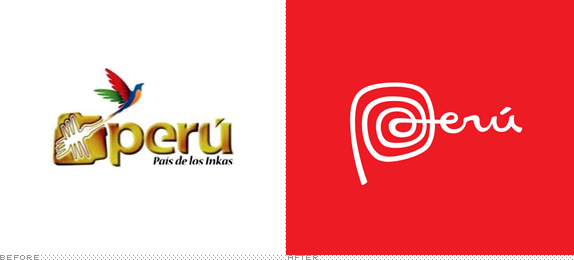
Anyways, seeing as I don't have much to report to you this week on changes in my life (school, homework, sleep, repeat), I'll be talking about the re-branding of Peru! What's that you might ask? Well a few weeks ago a friend informed me that the tourism office of Peru has recently re-branded their entire image. Below is a sample of the drastic changes that have been made. The old version is on the left, and the new version is on the right:


Quite a change, isn't it? The tourism office has even had its very own font designed that it will use in all official publications. If you want a complete look at their new website, you can follow this link: http://www.peru.travel/en/ I'm assuming that this new branding scheme will be in full effect by the time I arrive in late August or early September, but I'll report back to you on that one!

I find this re-branding quite interesting, actually. In my Marketing and Communication class we have been discussing how to make yourself stand out among the 'noise' and make yourself heard so that you can draw people in. This is especially important in international development, where non-governmental organizations and charities are constantly on the look-out for donor funding and support. I guess tourism bureaus face similar challenges, especially when large world events such as economic recessions/depressions occur. They are constantly looking for new ways to draw people in and entice them to come visit their culture, landscapes, and heritage. Here is the new publicity video to incite viewers to visit Peru (it is in Spanish, but worth watching for the pictures and music):


After watching the video I am so excited to be travelling to Peru in the near future, and can't want to discover all that is has to offer. Hopefully you'll do the same sometime soon (you can even come visit me!).

What do you think of the new branding image? Better/worse/indifferent? I'd love to hear your opinion. In the following weeks I'll be posting one of the new ads/slogans to visit Peru in each blogpost. Make sure you keep reading so you don't miss any! Have a great week!

Sheila

Thursday, March 17, 2011

Sand dams

Hello!

As I mentioned last week, this post is dedicated to telling you about a new technology that I have been learning about this semester called sand dams (http://www.sanddam.org/). Sand dams are a new, up and coming technology that can be used in drought-prone regions or places where harnessing and storing water is difficult. The construction of sand dams helps in recharging aquifers (or ground water) so that wells and hand pumps in the area can extract water from the ground. Here is a picture of what a sand dam looks like:


Sand dams are dams that are built across seasonally dry river beds. The area must be appropriately selected, preferably with large boulders or rocks on either side of the river beds to serve as supports for the dam. Initially, you build a dam that is only a few feet high. When it rains, some of the water will be retained to form a reservoir. More importantly though, all of the sediment that is being carried by the rainwater will be blocked from continuing downstream from the dam. As the sediment builds up, water will continue to flow over the dam. The dam is only supposed to affect a maximum of 10% of streamflow so that communities downstream can continue to use the water for sanitary and irrigation purposes. The following year, another addition to the sand dam is made to make it a little bit higher. When the river floods again, some of the water will remain in the area, sediment will build up, and more water will flow over the dam. The idea here is to create a reservoir and give the water the chance to be absorbed into the ground to recharge the aquifer. The picture below gives you an idea of how a sand dam is built: